
Youth Development Placement Transitions
York County Human Services operates the Youth Development Center for referred young people. The county describes it as a least-restrictive, short-term setting for dependent or adjudicated youth ages 10 through 21. Referrals come through Juvenile Probation or Children and Youth Services. That role is not the same as the adult county prison, and “released inmate” is not an accurate label for a young person's placement transition.
A transition can return a young person to an authorized family setting, move the person to another placement, or carry out a juvenile court or agency plan. Public adult roster logic does not establish which occurred. The referring agency and juvenile court hold the context needed to interpret the change. The right contact depends on whether the referral came from Juvenile Probation or Children and Youth Services.
| Question | Authorized route |
|---|---|
| Current placement or transition plan | Contact the referring Juvenile Probation or Children and Youth Services worker. |
| Juvenile court order | Use counsel or the juvenile court's authorized access process. |
| Family discharge arrangements | Follow the assigned agency or center instructions. |
| Adult custody after a separate event | Use the adult system only when the responsible agency confirms it applies. |
Confirm Youth Development Discharge
Confirmation begins with legal authority to receive the information. Juvenile records are restricted, so a public name search is not the normal path. An authorized parent, guardian, counsel, or case participant should use the assigned worker, attorney, or court channel. Staff may need to verify identity and the person's relationship to the case before discussing placement.
Do not use absence from VINELink, PA SAVIN, PADOC, or a public UJS search as proof of discharge. Those tools serve adult custody or public court purposes and do not become equivalent juvenile locators. A missing adult result may simply reflect the fact that the youth matter belongs in a protected system.
- Identify whether Juvenile Probation or Children and Youth Services made the referral.
- Contact the assigned worker or counsel through an official, previously verified channel.
- Be ready to establish identity and authority to receive case information.
- Ask the authorized source to explain the placement transition and any required next step.
- Use adult systems only if the responsible authority confirms a separate adult custody matter.
Youth Development Center Contact
The county lists the Youth Development Center at 3564 Heindel Road in York and gives 717-840-7570 as its telephone number. The official center can route an authorized caller, but confidentiality rules may limit what staff can disclose. Do not ask staff to bypass the referring agency or juvenile court.
York County Youth Development Center3564 Heindel Road
York, PA
717-840-7570
The official York County Youth Development Center page describes the center's role and referral framework.
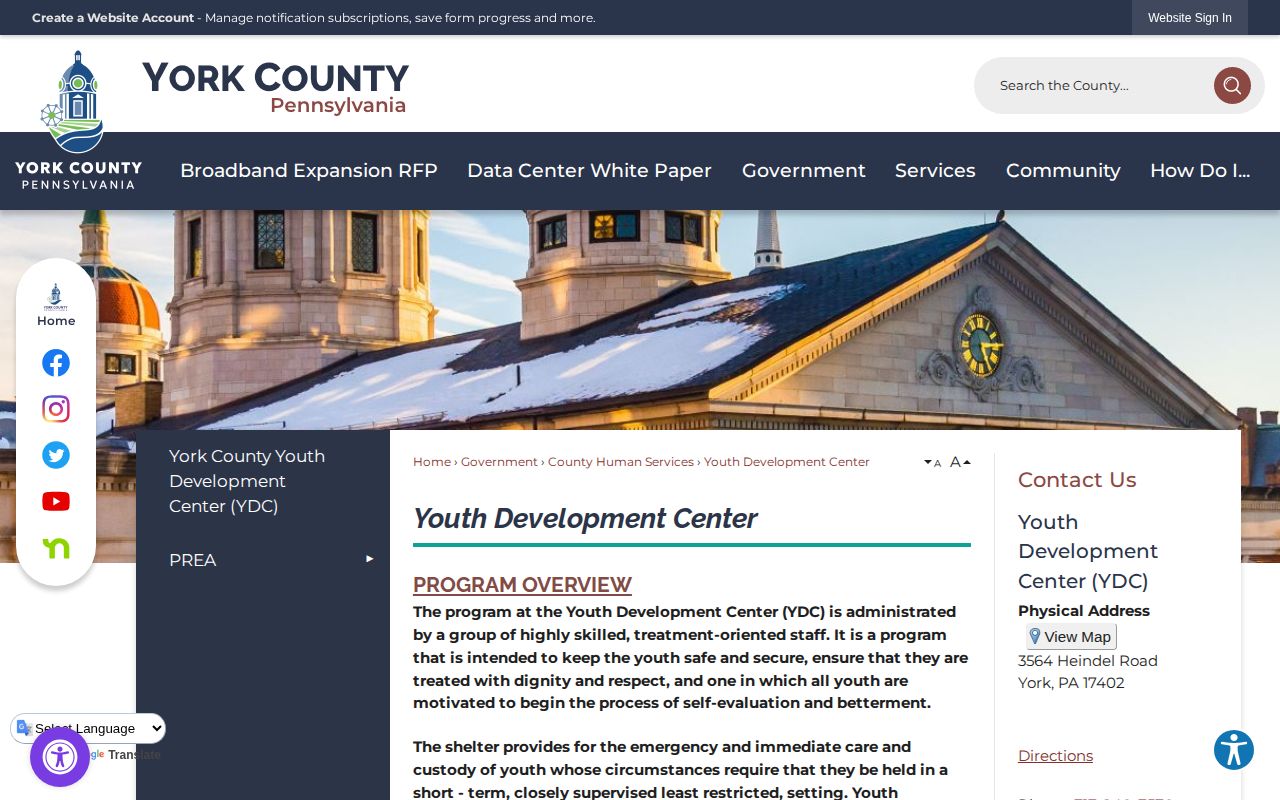
The county capture supports the center-specific facts while leaving protected individual placement information with authorized channels.
A request for an adult prison release record through the county's general Right-to-Know portal is not a substitute for juvenile case access. Juvenile confidentiality, court rules, and agency authority control. Counsel or the referring worker can identify the proper record process for a participant.
Youth Development Center Role
The phrase “least restrictive” describes the county's stated placement model. It does not mean that placement details are open to the public. “Short term” describes the program, not a promised number of days for any young person. No individual duration, discharge date, or destination should be inferred from the center's general description.
- Dependent youth
- A young person whose placement involves the child-welfare process.
- Adjudicated youth
- A young person whose juvenile court case resulted in an adjudication.
- Referral
- The authorized agency path placing a young person in the program.
- Placement transition
- A change carried out under the responsible juvenile authority's plan.
The age range given by York County is a program description, not evidence that any named person is or was at the center. The existence of a county juvenile service does not authorize a public search. Individual facts belong with the referring agency and court.
Note: General program details may be public even when the identity, placement, and discharge facts of a young person remain restricted.
Youth Development Authorized Records
Pennsylvania's victim-services material explains that criminal and juvenile justice systems have different processes and access boundaries. The official state justice-system explanation provides that wider context.
The state capture reinforces why adult custody notification should not be treated as a public juvenile placement search.
An authorized record may include a court order, agency case plan, referral document, or discharge instruction, but the research does not establish a public field list. Do not promise that any one document or field is publicly disclosed. The source office can explain what a party or counsel may receive and what proof of identity is needed.
The proper goal is accurate coordination, not public browsing. A family member who lacks formal authority may need to work through the legal guardian, counsel, or assigned case professional. If there is an urgent safety concern, use the responsible agency or emergency channel rather than an online search.
Youth Development Versus Detention
York County lists both a Youth Development Center and a Juvenile Detention Center. They should not be merged. The Youth Development Center has the documented least-restrictive, short-term program description and serves referrals from Juvenile Probation or Children and Youth Services. The Juvenile Detention Center has a separate detention identity within the juvenile-services context.
That distinction affects wording and routing. A YDC transition should be described as a placement or discharge handled under the case plan. A detention event should be verified through the authorized juvenile-court or referring-agency channel. Neither belongs in the adult county prison's public release workflow.
Adult information may become relevant only if an authorized source identifies a separate adult matter. Until then, searches of PA SAVIN, PADOC, BOP, or adult court dockets cannot replace direct case coordination.
Youth Development Information Boundaries
Public program information and protected case information can exist side by side. York County may publish the center's mission, referral sources, address, telephone, and age range. Those facts do not reveal whether a named young person was referred, remains placed, or completed a transition. Only the authorized juvenile channel can connect a person to a case.
The same rule applies to records. A general description does not promise access to a case plan, court order, discharge instruction, or destination. Ask the responsible custodian what an authorized party may receive. If counsel is involved, use counsel to navigate court access. Do not send personal juvenile information through an unrelated adult locator or public-facing form.
A precise account also keeps program types distinct. The Youth Development Center's least-restrictive description comes from its official page. It should not be applied to the separately named Juvenile Detention Center. Likewise, the detention label should not be used to recast every Youth Development Center referral as secure custody. Facility-specific language protects both accuracy and privacy.
Youth Development Transition Questions
An authorized participant can make the call more useful by asking narrow, case-based questions. Confirm which agency controls the plan, whether an order changed the placement, which person may receive instructions, and what action is required next. Do not ask for a public list or the names of other young people. The agency can discuss only what the caller is allowed to receive.
Terminology should follow the source. A move to another program is a placement transition, not necessarily release to family. Completion of one short-term placement does not reveal whether court or agency supervision ended. Likewise, a return to a family setting does not make the juvenile record public. The court and referring agency keep their own roles.
If records are needed, identify the specific order or instruction and the caller's relationship to the case. General county open-record procedures do not override juvenile restrictions. An authorized request may still receive limited or redacted information. That response should be respected and, if necessary, addressed through counsel or the record custodian's stated review process.
Keep dated instructions with the case contact's name. A later court or agency direction may change the plan, so confirm which instruction is current before arranging transport or pickup. This check supports the authorized transition without turning private placement facts into public search content.